
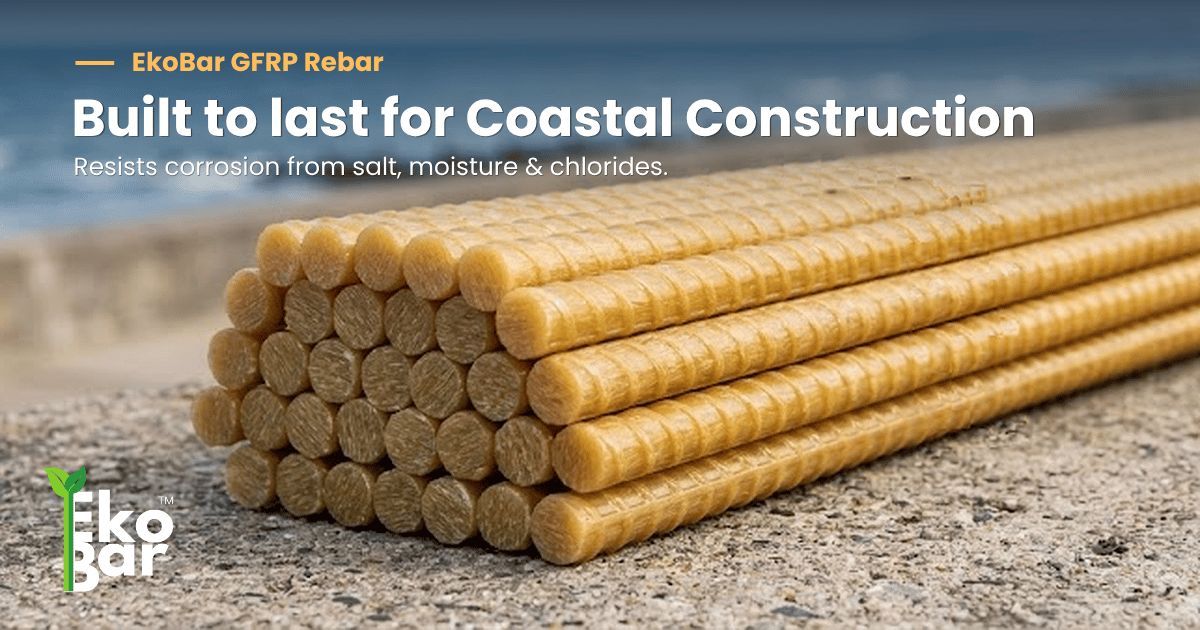
Building near the coast comes with its own challenges. Constant exposure to moisture, salt, humidity, and chlorides can affect concrete structures over time. Buildings, bridges, roads, retaining structures, and marine infrastructure need reinforcement that can perform reliably in these conditions.
This is where EkoBar GFRP rebar in coastal construction is gaining attention as an alternative to conventional steel reinforcement, especially in projects where corrosion resistance is important.
Why Is Corrosion a Challenge in Coastal Construction?
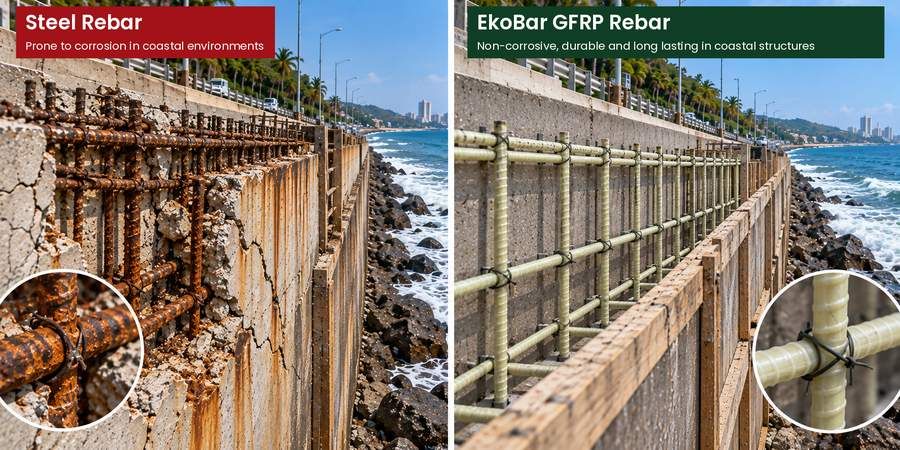
Concrete normally protects steel reinforcement from the surrounding environment. However, in coastal areas, chloride ions from seawater and salt-laden air can gradually penetrate the concrete.
When these chlorides reach steel reinforcement, they can trigger corrosion. As corrosion progresses, the steel can expand, which may lead to cracking, spalling, and deterioration of the surrounding concrete.
For structures designed to remain in service for decades, managing corrosion is an important part of long-term construction planning.
How Does GFRP Rebar Handle Chloride Exposure?
GFRP stands for Glass Fibre Reinforced Polymer. It is made using high-strength glass fibres embedded in an epoxy resin.
Unlike steel reinforcement, GFRP does not rust and offers resistance to corrosion. This makes GFRP rebar for coastal construction relevant for concrete structures exposed to moisture and chloride-rich environments.
Its combination of corrosion resistance, high tensile strength, and low weight makes GFRP rebar suitable for selected coastal and marine construction applications, depending on project requirements.
Benefits of GFRP Rebar in Coastal Construction
- Corrosion Resistance: One of the key advantages of GFRP rebar in coastal environments is its resistance to corrosion. Since it does not rust like steel, it can help address reinforcement-related deterioration associated with chloride exposure.
- Lightweight and Easy to Handle: GFRP rebar is approximately 75% lighter than steel while offering high tensile strength. Its lower weight can make transportation, handling, cutting, and placement easier at the construction site.
- Long-Term Durability: Coastal infrastructure is exposed to demanding environmental conditions for extended periods. Corrosion-resistant reinforcement can help reduce one of the major causes of reinforcement-related deterioration in chloride-exposed concrete.
- Lower Maintenance Requirements: Corrosion can contribute to concrete damage and lead to repair and rehabilitation work overtime. Since GFRP does not rust, it can help reduce maintenance requirements associated specifically with reinforcement corrosion.
Lifecycle Cost: Looking Beyond Initial Material Cost
The cost of reinforcement goes beyond its initial purchase price. For coastal projects, maintenance, corrosion-related repairs, rehabilitation, and replacement can add to the overall cost throughout a structure's service life.
Because GFRP rebar is resistant to corrosion, it can help reduce repair and maintenance requirements linked to reinforcement corrosion. Its lightweight nature can also simplify transportation and handling during construction.
Considering the lifecycle cost rather than only the initial material cost can therefore provide a broader view when evaluating reinforcement options for coastal projects.
Where Can GFRP Rebar Be Used?
GFRP rebar can be considered for a range of coastal and marine construction applications, depending on structural requirements and applicable design standards.
- Coastal Buildings: Concrete elements in buildings near the coast can experience prolonged exposure to humidity, moisture, and salt-laden air.
- Bridges and Roads: Bridge decks, barriers, pavements, and other concrete infrastructure can be exposed to moisture and chloride-rich conditions.
- Marine Structures: Seawalls, waterfront structures, and other concrete elements exposed to marine environments can be potential applications for GFRP rebar.
- Retaining Walls and Coastal Infrastructure: Retaining structures and other infrastructure exposed to moisture and coastal conditions can also be considered for corrosion-resistant reinforcement.
With its combination of corrosion resistance, high tensile strength, and lightweight properties, GFRP rebar offers an alternative reinforcement solution for environments where moisture and chloride exposure are important factors.
EkoBar GFRP Rebar
Made by ZippMat at Dobbaspet, Bangalore — the first and only GFRP manufacturer in Bangalore.
EkoBar GFRP is a lightweight, high-strength and corrosion-resistant alternative to steel reinforcement for selected coastal and marine construction applications, helping address reinforcement-related corrosion in chloride-rich environments.
Looking for a corrosion-resistant alternative to traditional steel reinforcement? Explore EkoBar GFRP
ZippMat Pvt Ltd | EkoBar
contact@zippmat.com · +91 93640 07918 · www.ekobar.in