
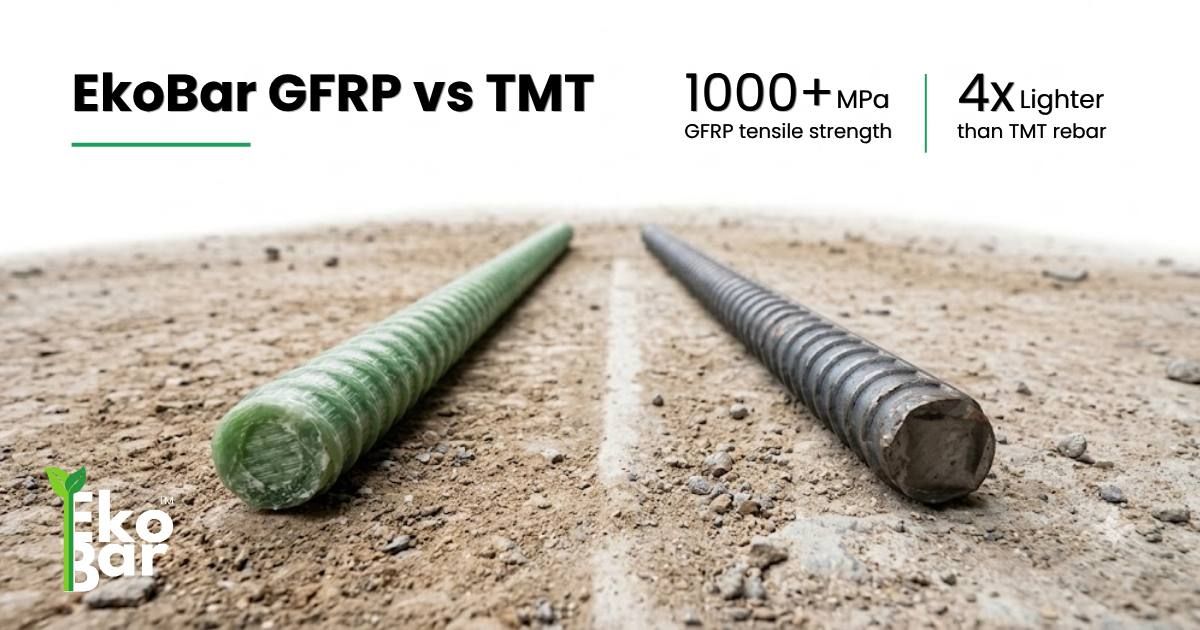
Which reinforcement is stronger? That's usually where the comparison starts — and where it stops. But strength is only one part of the decision. Weight, corrosion resistance, handling, durability, and total project cost all shape which material actually performs better on your site.
GFRP (Glass Fibre Reinforced Polymer) rebar is a composite reinforcement bar made from glass fibres set in a resin matrix, used as an alternative to steel reinforcement in concrete. Unlike TMT - GFRP contains no steel at all, which is what gives it a fundamentally different weight, corrosion, and performance profile from the start.
Here's how GFRP rebar vs TMT compares across the factors that matter.
At a Glance
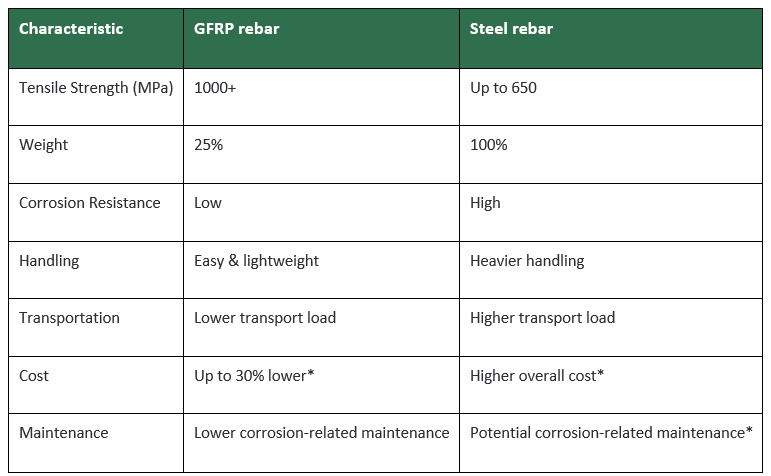
*Actual cost and maintenance requirements vary by project, design and exposure conditions.
Strength: What 1000+ MPa Actually Means
MPa (megapascal) is a unit used to measure how much pulling force a material can withstand. So, when EkoBar has a tensile strength of 1000+ MPa, it means the rebar can withstand more than 1,000 MPa of pulling force before it reaches its tensile strength limit.
What makes this significant is that GFRP rebar achieves this high tensile strength while being much lighter than steel reinforcement. In practical terms, EkoBar combines high tensile strength with lower weight, making it easier to handle, cut and place on site.
Weight: A Practical Difference on Site
This is where the difference becomes visible on the ground. GFRP rebar is roughly one-fourth the weight of steel for comparable sizes — which makes carrying, cutting, and placing it noticeably easier during construction.
For projects with large reinforcement quantities, that lower weight adds up: simpler handling, less physical strain moving material from storage to installation point, and fewer bottlenecks on site.
Corrosion: A Major Difference
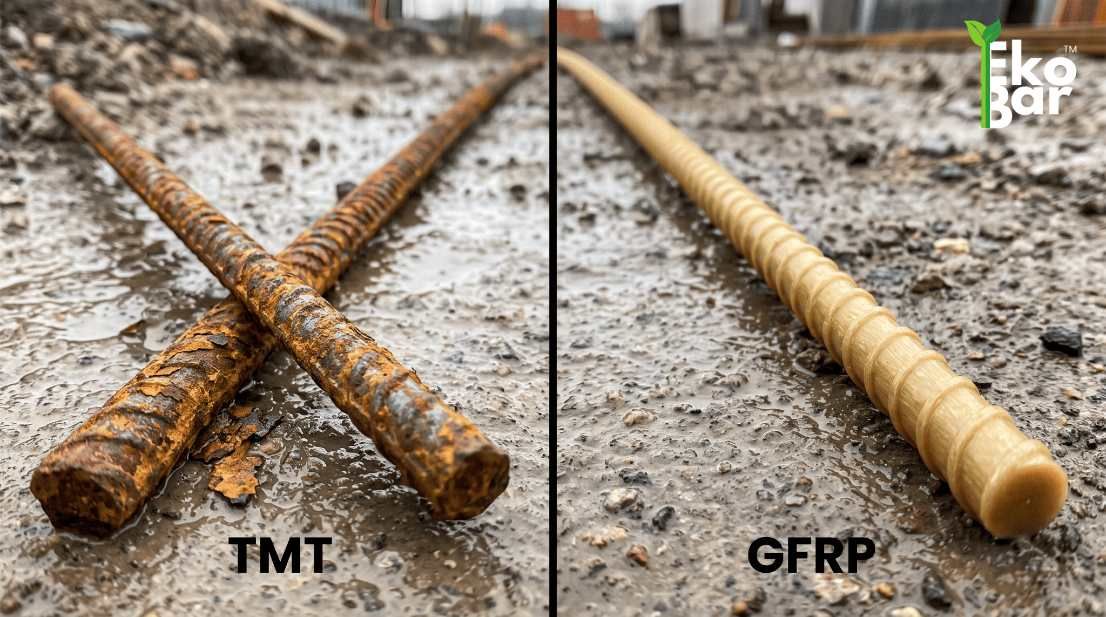
Steel reinforcement corrodes when moisture, chlorides, or other aggressive elements reach it. Over time, that corrosion causes the steel to expand — which can crack and weaken the surrounding concrete.
GFRP doesn't rust. That makes it especially relevant for:
- Coastal structures
- Water-related infrastructure
- Parking structures
- Certain road applications
Anywhere corrosion-related deterioration is a real long-term concern, GFRP removes that risk at the material level rather than managing it with coatings or maintenance.
Because it doesn't corrode, GFRP is also built for the long run — EkoBar GFRP rebar is engineered for 80+ years of service life, well beyond the 25–30 year corrosion-related maintenance cycle typical for exposed TMT structures.
Non-Magnetic & Non-Conductive: A Specialised Advantage
TMT, being steel, is magnetic and electrically conductive — a limitation in applications like MRI rooms, electrical substations, and other sensitive infrastructure where magnetic interference or conductivity is a risk. GFRP is non-magnetic and non-conductive by nature, making it suitable for these specialised projects without additional design workarounds.
Cost: Look Beyond Material Price
GFRP rebar can be up to 30% cheaper than TMT, depending on the project. And because it's around a quarter of the weight, transportation and handling costs drop too — lower weight means easier movement, faster placement, and potentially reduced labour requirements. Corrosion resistance adds another layer of savings by cutting down rust-related repair and maintenance costs over the structure's service life.
The real comparison isn't price per kg. It's: material + transportation + labour + handling + maintenance.
So, Which One Should You Choose?
It depends on your project's requirements. But when you weigh strength, weight, corrosion resistance, cost, and long-term durability together — not strength alone — GFRP rebar offers a combination that makes it a strong alternative to traditional steel reinforcement, particularly where lightweight handling and corrosion resistance matter most.
EkoBar GFRP Rebar
Made by ZippMat at Dobbaspet, Bangalore — the first and only GFRP manufacturer in Bangalore.
EkoBar GFRP rebar is built for applications where high tensile strength, lightweight reinforcement, and corrosion resistance matter.
Want to see how GFRP compares with TMT for your specific project? Explore EkoBar's GFRP rebar range.
ZippMat Pvt Ltd | EkoBar
contact@zippmat.com · +91 93640 07918 · www.ekobar.in