
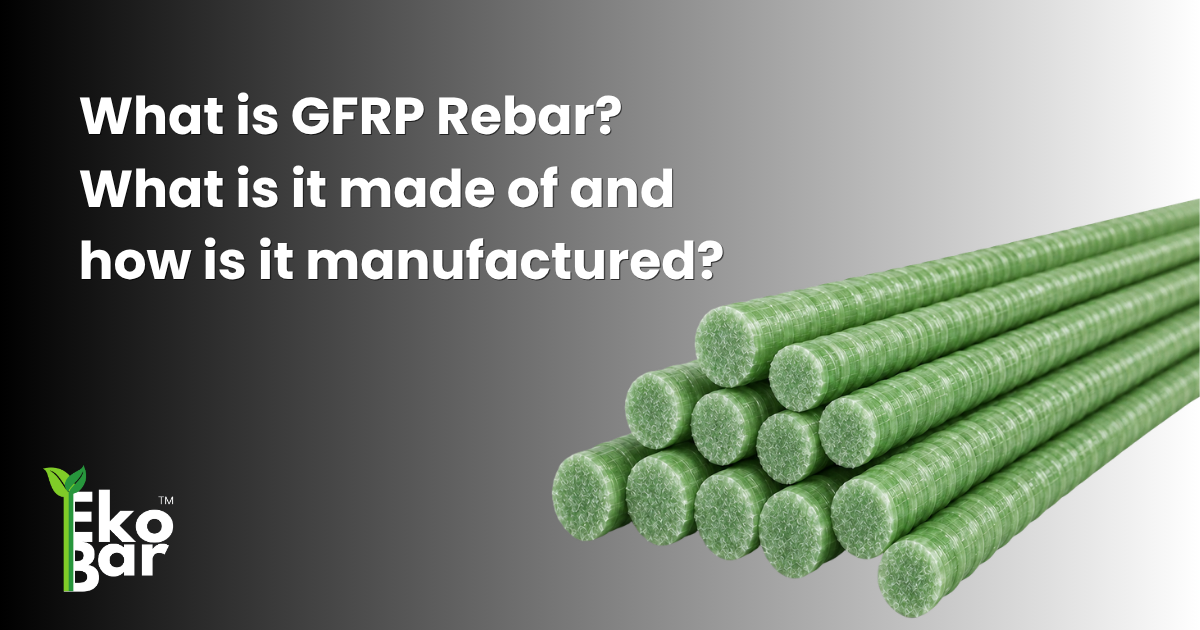
What is GFRP rebar?
Glass fibre and epoxy resin, pulled into a bar. It does the same job as steel reinforcement inside concrete — and behaves differently in almost every other way.
EkoBar by ZippMat · Manufactured in Dobbaspet, Bangalore
What it's made of
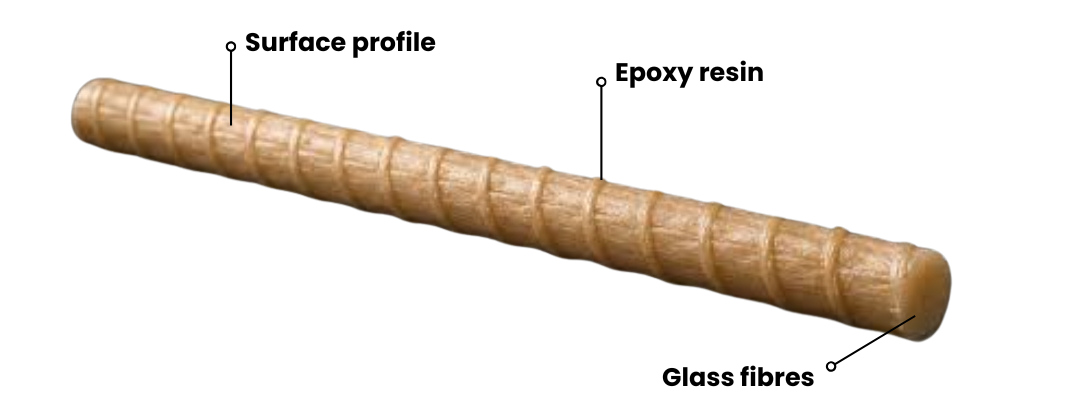
GFRP stands for Glass Fibre Reinforced Polymer. It is a non-metallic composite bar: continuous glass fibres running along the length of the bar, held together by epoxy resin, with a profiled surface so concrete can grip it.
You'll also see it called glass fibre rebar, fiberglass rebar or composite rebar. Same material, different names.
The three parts
Glass fibres — the load-carrying part. They run continuously along the bar, so tensile force is carried along its length. Fibre type and quality set the mechanical performance.
Epoxy resin — binds the fibres together and transfers load between them.
Surface profile — gives the bar the grip it needs to bond with concrete.
How it's made
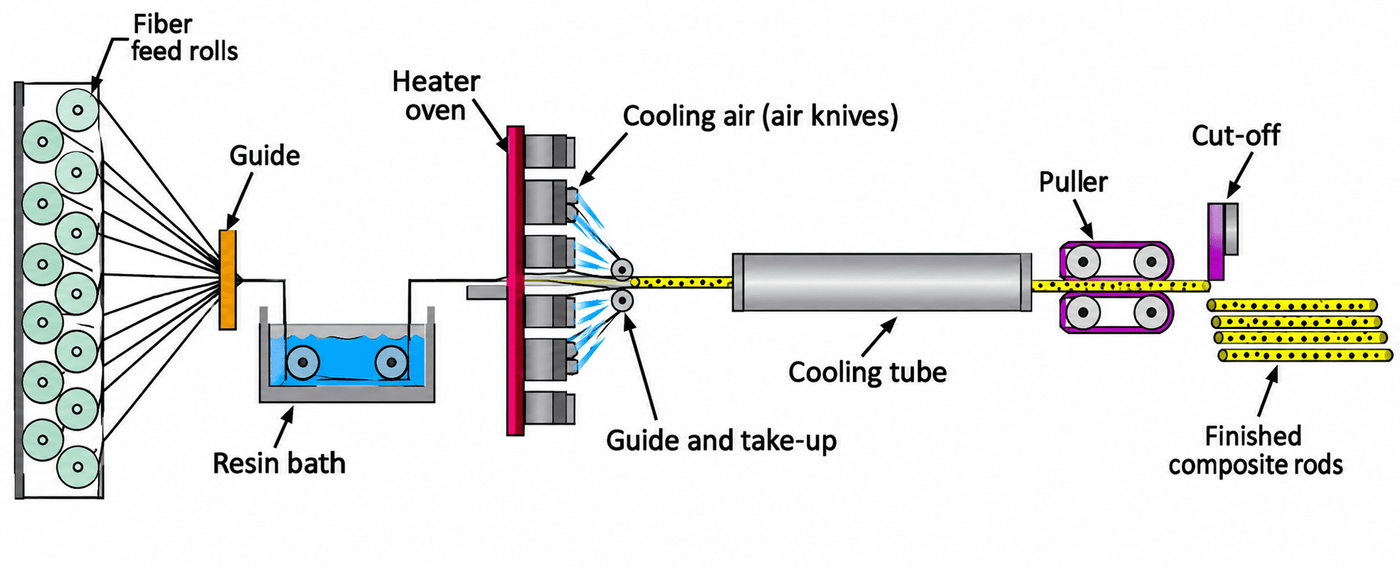
GFRP rebar is produced by pultrusion — a continuous line rather than a batch process.
Step 1 — Feed: continuous glass fibre rovings are drawn off the creel and fed into the line, all running in the same direction.
Step 2 — Impregnate: the fibres pass through a resin bath and are fully wetted out.
Step 3 — Form & cure: the wetted fibres are pulled through a heated die, which shapes and cures the bar.
Step 4 — Profile: the cured bar receives its surface profile for concrete bond.
What it does inside concrete
Concrete is strong in compression and weak in tension. Reinforcement is there to carry the tensile force. When a slab or beam bends, load transfers between the concrete and the bar through the bond at their contact surface — and the aligned glass fibres carry it.
That much is the same as steel. What differs is how the bar responds: GFRP has its own tensile strength, its own stiffness, and it does not yield the way steel does. Designs are worked out to GFRP codes such as IS 18256 and ACI 440, not by substituting bar-for-bar.
GFRP vs Steel, at a glance
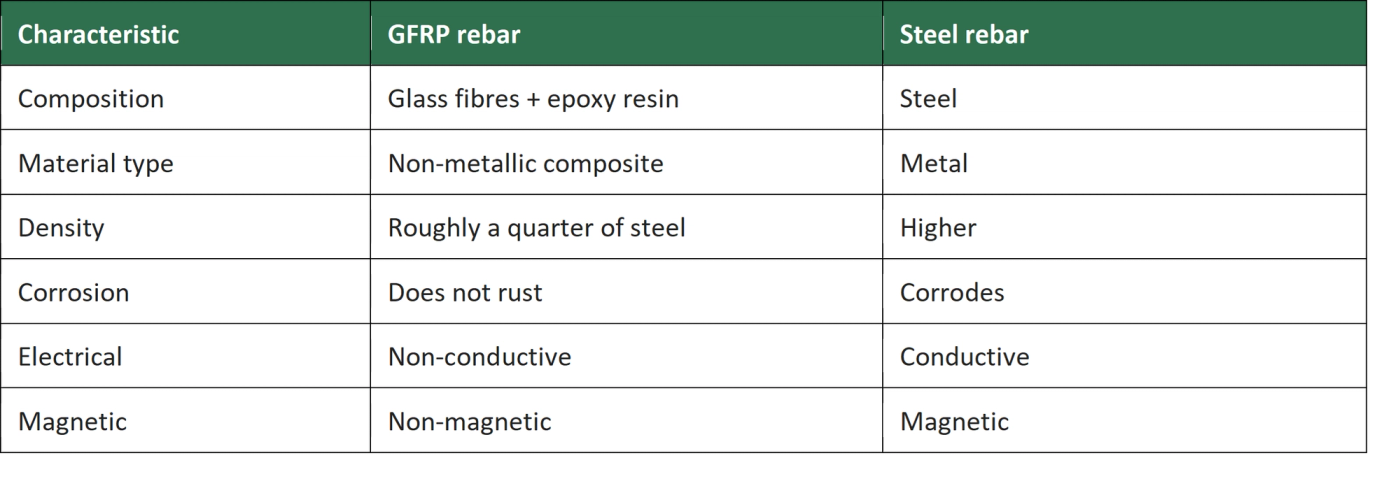
GFRP is not steel in a different colour. It is a different material with its own design rules.
Where it gets used
Roads & bridges
- Concrete roads & pavements — continuously reinforced slabs
- Bridges & decks — deck slabs, approach slabs, barriers
- Tunnels — soft-eye sections for TBM breakthrough
Water & marine
- Water & wastewater — tanks, channels, treatment works
- Coastal & marine — sea walls, jetties, splash zones
- Irrigation & hydraulic — canal lining, headworks
Buildings
- Foundations & basements — rafts, retaining walls
- Parking structures — decks exposed to de-icing salts
- Industrial floors — chemical exposure, MRI and data halls
GFRP earns its place where corrosion, weight, conductivity or magnetic interference are real constraints — not in every concrete pour.
EkoBar GFRP Rebar
Made by ZippMat at Dobbaspet, Bangalore — the first and only GFRP manufacturer in Bangalore.
Want to understand how GFRP compares with steel in terms of strength, weight and cost? Read the next guide in this series or explore EkoBar's GFRP rebar range to see if it's right for your project.
ZippMat Pvt Ltd | EkoBar
contact@zippmat.com · +91 93640 07918 · www.ekobar.in